
Is Versatility Quietly Hindering Korean Players?
why a multi-faceted skillset could be holding Koreans back in Europe

Just checking in: Remember how my last post was about experimenting? Well, that’s where I am right now with writing. I’m in my state of experimentation. If you have to know something about me as a person, it’s that I’m a bit of a perfectionist. I can’t stand making mistakes. Not even a typo.
I always put a lot of pressure on myself. Even for a free newsletter.
It’s a dumb way to live, but alas.
The past three months, I’ve written this newsletter every week, trying to make it as perfect as possible. But that shouldn’t be what true writing is all about; it should be free-flowing, fun, an extension of brain to pen.
I’m not saying I’m not proud of what I’ve produced. I’m actually quite pleased with what I’ve written, and everything has been in line with what I want to talk about. But sometimes, I spent hours editing and re-editing material, and that just bogs down the entire process.
Going forward, I’m going to try to make things as unfiltered and real as possible, even if there are some mistakes. I think that’s the true nature and strength of writing.
Now…onto the question of versatility in Korean football.
When Thiago Alcantara was announced back at Barcelona to join Hansi Flick’s coaching staff, he had this to say about versatility:
“I really like, let’s say, the versatility of a player who can cover different phases, both defensive and offensive; who can act as a pivot or operate as a 10…
“For me, midfielders must have that versatility I mentioned. They have to be able to be fearless on the ball, to contribute defensively.”
Versatility in modern football is generally an asset. Like Thiago says, being versatile makes players more useful overall. If footballers were robots, you’d want all of their stats to be maxed out, wouldn’t you? In Football Manager terms, 20s across the board. Being good at multiple things helps players avoid being exploited, elevating the floor of the entire team.
And with how complex and interchangeable systems can be nowadays, you need multidimensional players. Fullbacks invert into midfield in possession, 10s push up to press high alongside a lone forward, and goalkeepers are important initiators of the build-up. But we rarely talk about the downsides to versatility, and it’s a real issue Korean players deal with today.
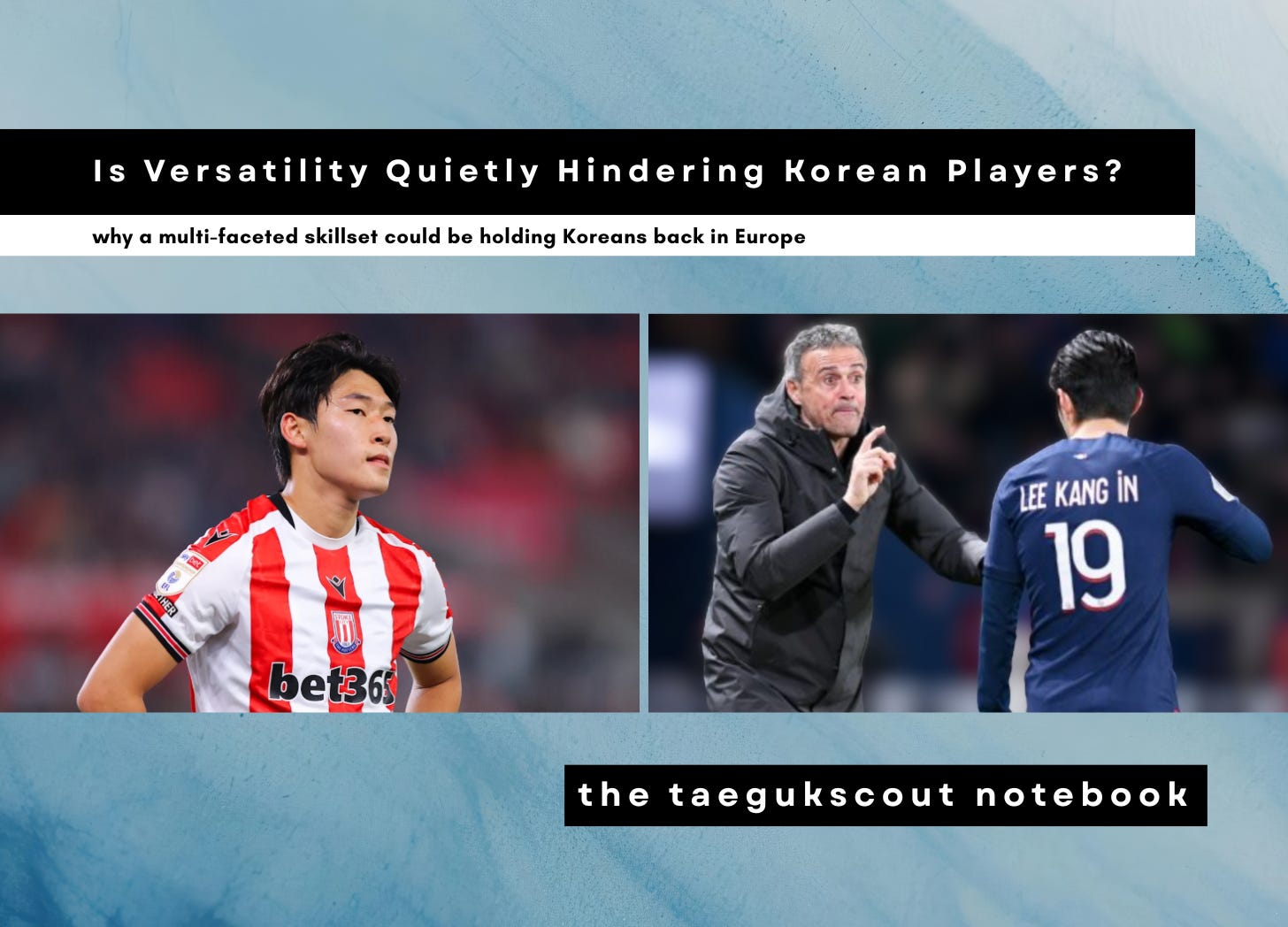
Over the past few years, I’ve seen a plethora of multi-faceted players in Korean football, especially in terms of midfielders and forwards. To name a few: Lee Kang-in, Eom Ji-sung, Bae Jun-ho, and Lee Hyun-ju. All are versatile, talented, and play in Europe. While the quartet are all still under 25, it’s hard to say that any of them, UCL winner Lee Kang-in included, have really hit their strides in Europe yet.
Let’s start with Kang-in, the most naturally talented footballer of the bunch. Extremely technical, blessed with a pure left foot and soondubu1 touch, armed with fantastic vision. And of course versatile, capable of playing any of the attacking positions in addition to his preferred CM/AM roles.
While he’s definitely proved his worth to PSG, he hasn’t even scratched the surface of what he can do as a playmaker over an entire season. He’s yet to start in more than 19 league games in a season for PSG. At the same age, Park Ji-sung started 23 games in his debut campaign for Manchester United.
Though currently injured, Kang-in has played 14 league matches for PSG this season: seven at RW, six at CM, and one at CF2. Last season, the distribution was even wilder. He essentially played every outfield position apart from CB, DM, and LB.
PSG manager Luis Enrique highly values Lee Kang-in’s versatility, having already ruled out a move away for him last summer. And it’s pretty easy to see why.
A versatile player like Kang-in can cover for injured players and add depth in needed areas, crucial when a club plays in multiple competitions, as PSG does. But we also have to take into account that using a player in multiple positions can dampen output and slow development, especially when someone like Kang-in is at his best centrally.
With rumors recently linking him to Atletico Madrid, it wouldn’t be surprising to see him tempted to leave Paris.
The situation with the two Championship boys, Eom Ji-sung and Bae Jun-ho, is different.
They haven’t often been played out of their best positions to accommodate the team like Kang-in has, but they may have been misprofiled. Or from the player/manager point of view, perhaps they could use more specialized skills.
At Swansea, Eom Ji-sung has played most of his minutes at LW. Good at many things, but not elite in areas he needs to thrive as a Championship winger, such as consistent finishing or aggression in the final third. For me, he’s at his best in a creative free role at LW/AM where he can influence the build up, get into a rhythm early, and create through crosses and smart line-breakers. That’s how he shined at Gwangju.
Bae Jun-ho is somewhat similar to Ji-sung, technically proficient and capable of playing LW, AM, and CM. He’s mainly split his time between LW and AM for Stoke City, but I see him as more of an AM or CM who can connect the midfield with attack. Like Ji-sung, he’s well-rounded but isn’t a typical goalscoring LW that we are accustomed to seeing in today’s game.
Do both players have potential as goalscorers? Sure. Ji-sung shoots well with both feet while Jun-ho’s off-ball movement can be dynamic.
But at the end of the day, Eom Ji-sung and Bae Jun-ho are best as playmakers.
Now, let me pose an interesting question to you.
If you are a manager, do you:
Play players in their preferred position and role to get the most out of them, and hope their weaknesses can be honed over time?
Play players in their secondary position and role to challenge them to work on their weaknesses?
I guess this depends on your philosophy. Personally, I would go with option 1. Help players settle, build up their confidence, and let the confidence carry over into other aspects of their game. But I do see the appeal of the 2nd option as well.
Versatility creates good problems for the manager to solve. It gives managers more flexibility with their tactics, which is why it’s so highly valued.
For players, it isn’t always easy to be versatile. It means changes in roles, unique position-specific instructions, and uncertainty from game to game. But that isn’t always bad.
Learning multiple positions can help players improve their knowledge of the game. They can see different angles and implement new approaches to their game. Playing at RW at Hannover last season, for instance, forced Lee Hyun-ju to work on his playmaking.
However, while there are upsides to playing multiple positions, the bottom line is that Hyun-ju is still better suited to a goalscoring role on the left.
He wants to score goals, and one of his best assets is his ability to cut in from the left and shoot with his preferred right foot. On the right, that weapon is stifled.
Now, being too versatile or lacking specialization isn’t the only reason why Korean players fail in Europe. Some are simply not good enough. But for the four I’ve mentioned, I’d like to see what they can do in the right environment.
Overall, versatility is still a strength.
For teams that want to win games, it’s a necessity. For many managers, it’s a blessing. For players, it raises their floor and helps them see the game from multiple viewpoints. And of course, players understand that some sacrifices have to be made over the course of a season. There are just too many variables at play. Key players can get injured, the club might not be able to buy new players, or maybe certain players don’t want to play in other positions.
However, it can hurt players individually, especially younger players who are yet to find their playing style. You know they say, “Jack of all trades, master of none.” Being multi-faceted may be important in today’s football, but so is being a specialist, especially if you lack the skills required to succeed in a specific role.
Korean players in Europe have suffered because of their own versatility: a lack of starts in crucial matches, being seen as a squad player, or being played in roles that don’t suit them.
Just because players can play in a specific position doesn’t necessarily mean that they should.
There needs to be a better balance between versatility and specialization in Korean football. Player development should focus not only on rounding out skill sets, but also on identifying strengths early and maximizing the skills that matter.
🌍 Want to stay ahead of the curve and learn more about Korean football? Subscribe today.
Korean reference incoming: soondubu is Korean for “soft tofu”, so soondubu touch is essentially a soft first touch. i.e. Zidane is legendary for his soondubu touch. The more you know. By the way, thanks to Ryo Nakagawara’s newsletter, I now know footnotes are a thing on here. Be very afraid. Man, I’m craving soondubu jjigae now.
Transfermarkt seems to classify the CM spot in a 4-3-3 as an AM. It’s basically the same thing, just tactical semantics.
this is happening to Castrop at Gladbach too btw 😬